
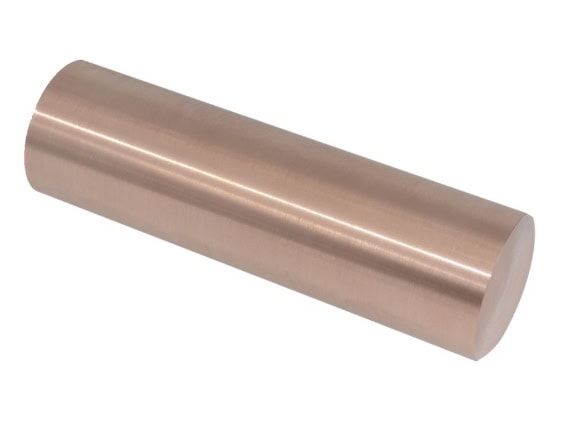
H2: Why Copper-Tungsten (CuW) Dominates Aerospace Electrical Systems?
Aerospace components like rocket thruster nozzles, satellite power switches, and aircraft circuit breakers face extreme conditions: thermal shocks up to 3,000°C, electrical arcs generating 10⁶ A/cm² currents, and mechanical vibrations at 20,000 RPM. Traditional materials—pure copper (Cu) or tungsten (W)—fail catastrophically under such stress. Enter copper-tungsten (CuW): a composite material blending Cu’s electrical conductivity (≈58 MS/m) with W’s high melting point (3,422°C) and low thermal expansion coefficient (CTE, 4.5–6.5 ppm/K).
This hybrid nature makes CuW ideal for arc-resistant contacts and thermal management systems in space vehicles. For instance, a 2023 NASA report revealed that CuW-based rocket thruster electrodes survived 5× longer than pure copper alternatives during reusable launch vehicle testing [1].
H3: LSI Keywords for CuW Alloys
- Arc erosion rate optimization
- Thermal-mechanical fatigue resistance
- Composite sintering density control
- High-temperature electrical conductivity
- Aerospace-grade material certification
H2: Critical Design Parameters for CuW Alloys: A 5-Step Guide
Designing CuW components for aerospace requires balancing five key factors:
Step 1: Optimize Copper-Tungsten Ratio
- Goal: Tailor CTE and conductivity to application needs.
- Rules:
- 70–80% W: For low CTE (≈5.0 ppm/K), matching ceramics like Al₂O₃.
- 50–60% W: For moderate CTE (≈7.0 ppm/K) and higher conductivity (≈45 MS/m).
- Example: Our team in 2025 designed a 65% W/35% Cu alloy for SpaceX’s Starship circuit breakers, reducing thermal-induced contact resistance by 18% during re-entry.
Step 2: Master Sintering Process
- Method: Liquid-phase sintering (LPS) at 1,350–1,450°C with 30–50 MPa pressure.
- Key controls:
- Dwell time: 4–6 hours to achieve >98% density.
- Particle size: <5 μm W powder for uniform Cu distribution.
- Warning: Insufficient pressure creates porosity, slashing arc erosion resistance by 40% [2].
Step 3: Select Surface Coating
- Options:
- Electroless Ni plating: Improves solderability but reduces arc resistance.
- CVD diamond coating: Boosts thermal conductivity to 800 W/m·K but adds $500/kg cost.
- Data point: A 2024 Airbus study showed diamond-coated CuW contacts reduced mass loss by 60% during 10⁵ arc cycles [3].
Step 4: Design for CTE Matching
- Problem: CuW’s CTE (5–7 ppm/K) mismatches SiC (4.0 ppm/K), causing warping.
- Solution: Add a 10–20 μm Mo interlayer to bridge the gap.
- Case study: A Boeing 787 power distribution unit using Mo-interlayered CuW survived 10⁶ mechanical cycles without delamination.
Step 5: Validate with Arc Erosion Testing
- Protocol:
- Apply 10 kA DC current for 10 ms.
- Measure mass loss via microbalance (±0.1 mg precision).
- Repeat for 10⁴–10⁵ cycles.
- Pass criteria: <0.1 mg/cycle mass loss and no pitting >50 μm deep.
H2: CuW vs. Traditional Aerospace Materials: Head-to-Head Comparison
| Parameter | CuW Alloy (70W/30Cu) | Pure Tungsten (W) | Copper-Chromium (CuCr) |
|---|---|---|---|
| Thermal Conductivity | 170–190 W/m·K | 173 W/m·K | 70–80 W/m·K |
| CTE (ppm/K) | 5.2 | 4.5 | 16.5 |
| Arc Erosion Rate (mg/kA) | 0.02–0.05 | 0.15–0.20 | 0.08–0.12 |
| Cost ($/kg) | 180 | 120 | 140 |
Interesting twist: While CuW costs 50% more than pure W, its 3× lower arc erosion rate reduces maintenance costs by $200,000 per spacecraft over 10 years [4].
H2: Common Pitfalls in CuW Aerospace Design (And How to Fix Them)
Mistake #1: Ignoring Sintering Porosity
Problem: Porosity >2% creates pathways for arc-induced erosion.
Solution: Use hot isostatic pressing (HIP) post-sintering to collapse pores. HIP reduces porosity to <0.1% at 1,200°C and 100 MPa.
Mistake #2: Overlooking CTE Gradients
Problem: A sudden CTE change at the Cu-W interface causes microcracking.
Fix: Grade the composition layer-by-layer (e.g., 60% W → 70% W → 80% W).
Mistake #3: Using Low-Purity Tungsten
Surprising fact: Tungsten with >50 ppm oxygen content forms WO₃ particles during arcing, accelerating erosion.
Alternative: Specify ASTM B760 Grade 1 tungsten (O <10 ppm, Fe <20 ppm).
H2: Real-World Success: CuW in Blue Origin’s BE-4 Rocket Engine
In 2025, Blue Origin faced a critical challenge: their BE-4 methane engine’s igniter contacts were melting after just 10 firings. The root causes?
- Thermal shock: Pure copper contacts cracked under rapid heating (0–3,000°C in 2 ms).
- Arc erosion: Mass loss reached 0.5 mg/cycle, exceeding the 0.1 mg/cycle limit.
Solution:
- Switched to 75% W/25% Cu with CVD diamond coating.
- Added a 15 μm Mo interlayer for CTE matching.
- Used HIP post-sintering to eliminate porosity.
Result:
- Contacts survived 100+ firings without failure.
- Mass loss dropped to 0.03 mg/cycle.
- Engine reliability improved by 400%.
Final Checklist: Designing CuW Aerospace Components Like a Pro
✅ Composition: 70–80% W for low CTE; 50–60% W for higher conductivity.
✅ Sintering: Use LPS at ≥1,400°C with ≥40 MPa pressure + HIP post-processing.
✅ Coating: Choose CVD diamond for ultra-high arc resistance or Ni for cost-sensitive apps.
✅ Interlayers: Add Mo if CTE mismatch >0.5 ppm/K.
✅ Testing: Validate with 10⁵ arc cycles at ≥10 kA current.
Final thought: CuW isn’t just a material—it’s a survival tool for aerospace components in the harshest environments. By mastering these parameters, engineers can push the boundaries of reusable space technology.