
Custom Heating Elements and Heater Assemblies for Vacuum and Controlled-Atmosphere Furnaces
Tungsten and molybdenum furnace heating elements convert electrical energy into heat inside vacuum and compatible controlled-atmosphere furnaces.
CHEMETAL USA custom designs and manufactures these complex and highly-specialized heating assemblies. Types include mesh; wire; strip; ribbon; rod; tube; and fabricated elements. We specialize in designs for new and replacement furnace systems, maintenance programs, and hot-zone rebuilds.
Working from customer specifications such as production drawings, CAD models, photographs, or existing samples, CHEMETAL USA’s expert team can produce efficient design and manufacturing blueprints for even scarce or uncommon heating elements. Our process is matched to each customer’s specific application. Our objective is to optimally combine metals, electrical requirements and terminals, element geometry, supports, connection points, and mounting locations. Our precision engineering ensures that the resulting element works as intended with its integrated power system and hot-zone layout.
Typical Furnace Crucibles
- Tungsten Mesh Heating Elements
- Tungsten Wire Heating Elements
- Molybdenum Wire Heating Elements
- Strip and Ribbon Heating Elements
- Rod and Tube Heating Elements
- Lanthanated Moly and TZM Heating Elements
- Custom Formed and Fabricated Heater Assemblies
CHEMETAL USA matches each unique element to its surrounding interdependent components. The result is optimal heat input according to heat-zone dimensions, workload, available installation space, and other application parameters. Every configuration shapes heat distribution differently. Mesh, for example, distributes radiant heat across a broad area; strip and ribbon designs cover wider sections and adapt to custom hot-zone layouts; rod and tube elements create more defined heating paths and provide greater structural rigidity.
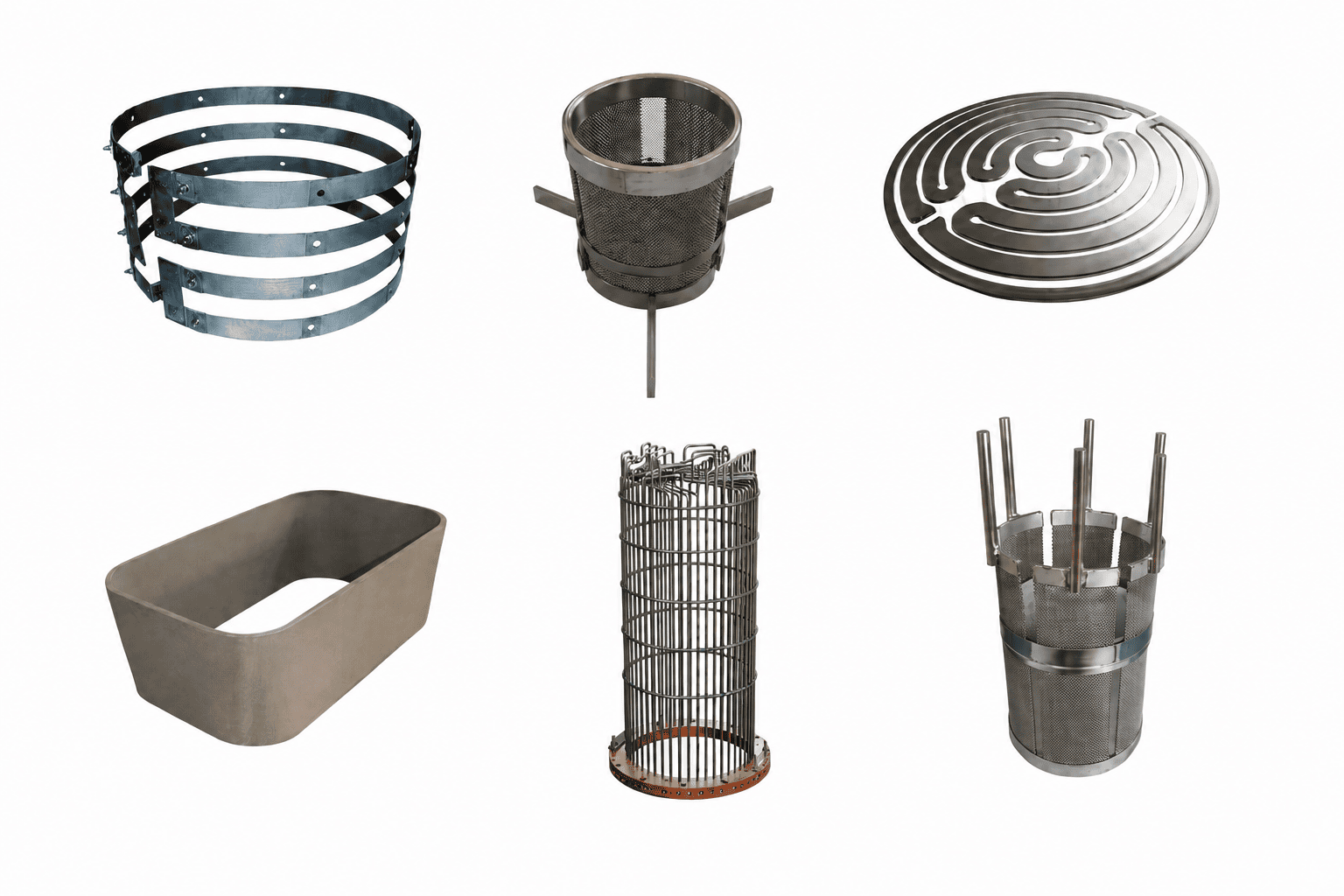
Custom Furnace Crucible Capabilities
| Your Requirement | What CHEMETAL USA Offers |
|---|---|
| Product Scope | Mesh, wire, strip, ribbon, rod, tube, and heater assemblies. |
| Material Options | Tungsten and molybdenum; MoLa and TZM for selected designs. |
| Manufacturing Capabilities | Cutting, forming, machining, joining, and assembly. |
| Project Support | New systems, replacement, maintenance, and hot-zone rebuilding. |
| Ways to Get Started | Drawings, CAD files, samples, dimensions, process material, and furnace data. |
Heating Element Materials and Manufacturing
Tungsten, molybdenum, lanthanated molybdenum, and TZM offer different performance profiles for high-temperature capability, manufacturability, and structural stability. CHEMETAL USA selects material and product form according to operating temperature; electrical requirements; element geometry; manufacturing method; furnace atmosphere; and process environment. At elevated temperatures, these metals are commonly used in vacuum or controlled, non-oxidizing atmospheres.
| Material | Where It Adds Value |
|---|---|
| Molybdenum | A versatile, cost-effective choice for many vacuum and controlled-atmosphere furnaces, with broad manufacturing flexibility across wire, mesh, strip, sheet, rod, and tube designs. |
| Tungsten | Selected for more demanding temperature conditions and applications where strength and dimensional stability at high temperature are priorities. |
| TZM | Available for selected heating-element designs where greater strength and better resistance to slow deformation (creep) at high temperature are beneficial, provided the electrical and manufacturing requirements are compatible. |
| Lanthanated Molybdenum | Available for selected heating-element designs where a higher recrystallization temperature and better ductility after recrystallization are valuable. |
From Refractory Metal Forms to Complete Heater Assemblies
CHEMETAL USA’s production team works with refractory-metal wire, mesh, strip, sheet, rod, and tube. The process may include precision cutting, forming, machining, fitting, welding, or other joining methods, and final assembly. We can supply the heat-generating element alone, or integrated with a complete heater assembly including electrical terminals, connectors, supports, and structural parts.
Shaping Heat Through Electrical and Geometric Design
The right heating element depends on how its electrical requirements and geometry work together—not on material alone. Operating temperature, required power, target resistance, element dimensions, spacing, arrangement, and support configuration determine where heat is generated and how it reaches the workload. Coordinating these factors with the furnace power supply, chamber dimensions, heated-zone layout, and surrounding hot-zone components.
Element geometry shapes the way heat moves through the furnace—where it’s generated, how broadly it’s distributed, and how directly it reaches the load.
Support design is equally important. As the heating element completes its temperature cycle, it expands and contracts. Its support system must accommodate this movement while preserving alignment, clearances, secure connections, and a continuous electrical path through repeated cycles.
Furnace Crucible Applications
CHEMETAL USA custom manufactures heating elements and heater assemblies for most high-temperature furnace systems, including:
- Vacuum furnaces — Primary heat sources in many refractory-metal hot zones.
- Hydrogen and reducing-atmosphere furnaces — Used where the atmosphere is properly controlled and compatible with the element material.
- Inert-atmosphere furnaces — Support high-temperature processing within a controlled, non-oxidizing environment.
- Sintering furnaces — Provide stable heat input through long thermal cycles for powder metallurgy, MIM, rare-earth magnets, and selected ceramic processes.
- Crystal growth systems — Used where heater geometry and placement are closely coordinated with the required thermal environment.
- Vacuum heat-treatment and brazing furnaces — Provide controlled, repeatable heat across the working zone.
- Semiconductor and specialized material-processing equipment — Manufactured in custom geometries for application-specific hot zones.
Custom and Replacement Heating Elements
Whether you require a single replacement element or a complete heater assembly, CHEMETAL USA is ready to meet the challenge. We support worn, damaged, obsolete, and difficult-to-source designs. We can often begin a project even when a complete original drawing is no longer available.
Useful starting information may include a drawing or CAD model; an existing heater sample; verified dimensions; photographs; furnace make and model; material type; heater power rating (kW) or resistance data; connection and support details; operating temperature; atmosphere or vacuum level; and the reason for replacement.
An existing sample can help us determine much of the physical layout, while furnace and electrical data help complete the design basis. Well before manufacturing begins, CHEMETAL USA uses this information to confirm geometry; material; resistance requirements; connection points; supports; clearances; and mounting interfaces.
Customers may order an individual element for installation into an existing system, or a complete heater assembly with electrical terminals, connectors, supports, fasteners, and surrounding hot-zone components.
Please explore CHEMETAL USA’s complete range of tungsten and molybdenum high-temperature furnace components.
Frequently Asked Questions
Which is better for a furnace heating element, tungsten or molybdenum?
Both are well-proven metals for heating element design. Tungsten is generally selected for more demanding temperature conditions, and for applications where strength at high temperature is a priority. Molybdenum offers excellent manufacturing flexibility and a practical balance of performance, availability, and cost. MoLa and TZM are also options for selected designs. The best choice is the material that matches the electrical requirements, geometry, atmosphere, support arrangement, and heating cycle of your furnace.
Can tungsten and molybdenum heating elements be used in air?
At elevated temperatures, tungsten and molybdenum-based heating elements are generally intended for vacuum or properly controlled non-oxidizing atmospheres. Exposure to air, oxygen, moisture, leaks, and other oxidizing conditions can damage the heating element.
Can a replacement heating element be made from an existing sample?
Yes. A replacement project can often begin with a sample, verified dimensions, photographs, furnace information, and available electrical data. CHEMETAL USA uses these and other available information to confirm material, resistance, connections, support locations, clearances, and operating requirements before production.
May We Quote You?
To help us review and quote your heating element requirement, please send us as much information as you can, which may include:
- Drawings, CAD files, physical samples, or photographs
- Material and preferred element form
- Overall dimensions, spacing, and critical tolerances
- Heater power rating (kW), supply voltage and current, or resistance data
- Connection points, electrical terminals, supports, and mounting details
- Furnace make and model, hot-zone layout, operating temperature, and atmosphere or vacuum level
- Materials being processed or workload details, required quantity, and whether the project is for a new furnace, replacement, maintenance, or rebuild
CHEMETAL USA will review the available information, identify any missing technical details, and work with you to determine the optimal material and manufacturing approach for the intended application of the crucible or related assembly.