
Custom Heat Shields and Radiation Shield Assemblies for Vacuum and Controlled-Atmosphere Furnaces
Heat shields are refractory metal barriers installed in industrial furnaces to reduce radiant heat loss, confine heat in the working zone, and protect surrounding structures. They are usually made of tungsten or molybdenum due to these refractory metals’ shared material properties— high thermal stability, strength at elevated temperatures, and low thermal expansion. “W” and “Mo,” respectively, also have significant differences in density, melting point, and machinability that make each ideal for different applications.
CHEMETAL USA has decades’ experience working with every aspect of heat shields, from concept to production. Our team includes experts in vacuum and compatible controlled-atmosphere furnaces and their related parts, including cylindrical shields; panels; rings; formed sections; individual layers; and complete multi-layer assemblies.
We provide solutions for both common and unique challenges—from individual shield parts or complete shield assemblies for new furnace systems to replacement applications, ongoing maintenance, and hot-zone rebuilding.
Custom Heat Shield Parts
- Flat shield panels
- Cylindrical heat shields and rings
- Inner shield layers
- Intermediate shield layers
- Outer shield layers
- Multi-layer radiation shield assemblies
- Spacers, fasteners, supports, and mounting hardware
Shield geometry is developed in accordance with required working-zone coverage, openings joints, mounting points, available furnace space, and access for installation or maintenance.
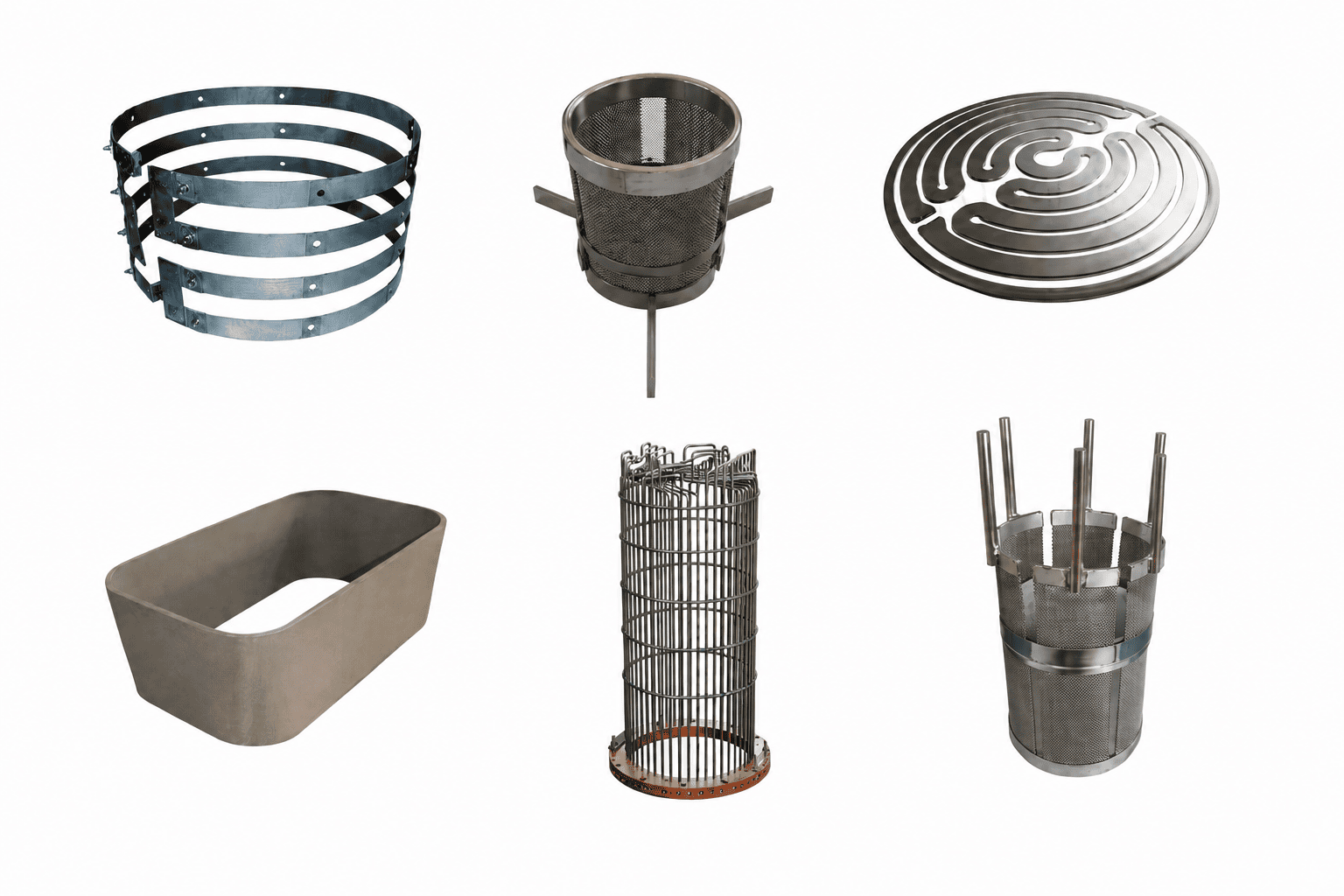
Custom Heat Shield Capabilities
| Your Requirement | What CHEMETAL USA Offers |
|---|---|
| Product Scope | Panels, cylindrical shields, rings, layers, and multi-layer assemblies. |
| Material Options | Tungsten and molybdenum; MoLa and TZM for selected designs. |
| Manufacturing Capabilities | Cutting, forming, machining, joining, and assembly. |
| Project Support | New systems, replacement, maintenance, and hot-zone rebuilding. |
| Ways to Get Started | Drawings, CAD files, samples, dimensions, process material, and furnace data. |
Heat Shield Materials and Manufacturing
Material selection is governed by shield location and furnace environment. Operating temperature, geometry, layer arrangement, support method, maintenance requirements, and process conditions also influence the choice. At elevated temperatures, tungsten, molybdenum, and TZM are generally used in vacuum or controlled non-oxidizing atmospheres.
| Material | Where It Adds Value |
|---|---|
| Molybdenum | Commonly used for panels, rings, formed sections, and multi-layer assemblies, with practical manufacturing flexibility for custom shield designs. |
| Tungsten | Selected for more demanding temperature conditions and applications where strength and dimensional stability at high temperature are priorities. |
| TZM | Available for selected heating-element designs where greater strength and better resistance to slow deformation (creep) at high temperature are beneficial, provided the electrical and manufacturing requirements are compatible. |
| Lanthanated Molybdenum | Available for selected heating-element designs where a higher recrystallization temperature and better ductility after recrystallization are valuable. |
Layer Configuration, Spacing, and Support
A heat shield assembly is not defined by layer count alone. Additional layers can reduce outward radiant heat transfer, but spacing, surface condition, openings, geometry, and support arrangement also influence the result.
A single layer may be suitable in some furnace locations, while multi-layer assemblies are used when greater control of radiant heat loss is needed. Layer count and sequence must fit the available space and work with the intended spacing, support, and maintenance access.
Openings, joints, fastener locations, and gaps create paths for radiant heat to pass. Their placement must work with heating-element connections, support points, furnace access openings, and other installation requirements.
During repeated heating and cooling (thermal cycling), shield layers expand and contract. Spacers and supports must maintain separation and alignment while allowing that movement. In replacement work, CHEMETAL USA confirms not only outside dimensions but also layer sequence, spacing, openings, hole locations, support points, mounting details, clearances, and fit.
Furnace Heat Shield Applications
CHEMETAL USA manufactures heat shields and radiation shield assemblies for furnace systems such as:
- Vacuum furnaces — Reduce radiant heat leaving the working zone and limit heat reaching the furnace enclosure and surrounding structures.
- Sintering furnaces — Help retain heat around the workload through extended high-temperature cycles.
- Hydrogen and reducing-atmosphere furnaces — Used where the atmosphere is properly controlled and compatible with the shield material.
- Crystal growth and semiconductor systems — Custom geometry, openings, and shield position are coordinated with the process area and hot-zone layout.
- Vacuum heat-treatment, brazing, laboratory, and specialized processing equipment — Use custom panels, rings, formed parts, and assemblies to retain heat and protect surrounding furnace structures.
Custom and Replacement Heat Shields
CHEMETAL USA supplies individual replacement panels, rings, shield layers, and complete multi-layer assemblies for existing and difficult-to-source furnace systems. A project can often begin even when the complete original drawing is no longer available.
Useful starting information may include a drawing or CAD model; an existing part or assembly; verified dimensions; photographs; furnace make and model; layer details; support and mounting information; and available operating conditions.
An existing assembly can establish much of the physical layout, but worn, distorted, missing, or modified parts may no longer represent the intended design. Before manufacturing, CHEMETAL USA confirms the material, layer sequence, spacing, openings, support and mounting points, clearances, and fit with surrounding hot-zone components. Related spacers, fasteners, supports, and mounting hardware can be supplied with the assembly.
Explore CHEMETAL USA’s complete range of tungsten and molybdenum high-temperature furnace components here.
Frequently Asked Questions
What is the difference between a heat shield and a radiation shield?
In furnace hot zones, the terms often overlap. Radiation shield more specifically describes a component designed to reduce heat transfer by radiation, while heat shield is the broader term for a part that limits heat transfer and protects surrounding structures. In many high-temperature vacuum furnaces, the same component serves both functions.
How is the number of heat-shield layers determined?
The number of layers is selected together with operating conditions, available space, layer spacing, surface condition, openings, support, alignment, and maintenance access. Additional layers can reduce outward radiant heat transfer, but the final design must balance control of radiant heat loss with the space and support available in the furnace.
Can a replacement heat shield be made from an existing sample?
A replacement evaluation can often begin with an existing shield or assembly, verified dimensions, photographs, furnace information, and available operating data. Additional measurements may be required if worn, distorted, missing, or modified parts no longer define the intended geometry or layer arrangement.
May We Quote You?
To help us review and quote your heat-shield requirement efficiently, please send any of the following that you may have available:
- Drawing, CAD file, physical sample, or photographs, plus whether the requirement is for an individual shield part or a complete assembly and the required quantity.
- Requested or currently used material, overall dimensions, openings, hole locations, layer count and sequence, spacing, and critical tolerances.
- Support and mounting details, furnace make and model, available hot-zone information, and surrounding clearances.
- Operating temperature, atmosphere or vacuum level, and whether the project is for a new furnace, replacement, maintenance, or hot-zone rebuild.
CHEMETAL USA will review the available information, identify any missing technical details, and discuss with you a practical manufacturing approach for the individual shield components or complete assembly.