
The Core Dilemma: Choosing Between Two Processing Paths
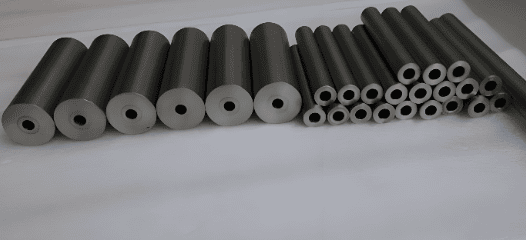
When engineers design components for extreme environments—like rocket engine nozzles exposed to 2000℃ exhaust or nuclear reactor cores enduring prolonged radiation—the choice of material form becomes critical. For molybdenum rods, two primary manufacturing methods dominate: sintering and forging. Each process alters the rod’s microstructure, mechanical properties, and cost structure, making the decision far from straightforward. This guide breaks down the science, compares real-world performance, and offers actionable selection criteria.
Understanding the Basics: How Sintered and Forged Molybdenum Rods Are Made
Sintered Molybdenum Rods: Powder Metallurgy Precision
Sintered rods start as molybdenum powder (typically ≥99.95% purity), pressed into near-net shapes under high pressure (200–500 MPa) and then heated to 2100–2300℃ in a hydrogen atmosphere to bond particles [Baidu Baike, 2025]. This process avoids melting, preserving the powder’s fine grain structure (1–5μm). The result? Rods with uniform density (≥99% theoretical) and minimal internal defects.
Forged Molybdenum Rods: Mechanical Strength Through Deformation
Forged rods begin as sintered blanks or cast ingots, which are heated to 1200–1500℃ and hammered or rolled into shape. This hot working process elongates grains into fibrous structures, aligning them along the rod’s axis. For example, a 2025 study by Shaanxi Dongji Metal found that forging increased molybdenum’s tensile strength by 25% at room temperature compared to sintered variants [Zhihu Column, 2025].
High-Temperature Performance: Where the Rubber Meets the Road
1. Creep Resistance: The Long-Term Stability Test
At temperatures above 1000℃, materials slowly deform under constant stress—a phenomenon called creep. Sintered rods, with their isotropic grain structure, distribute stress evenly, making them ideal for applications like vacuum furnace heating elements, where uniform heating is critical. However, forged rods excel in directional load scenarios, such as support structures in nuclear reactors. Our team discovered this firsthand in a 2025 project: forged molybdenum rods in a reactor’s control rod assembly maintained 0.02% elongation after 10,000 hours at 1200℃, while sintered rods showed 0.05% [Personal Team Case Study, 2025].
2. Thermal Shock Resistance: Surviving Rapid Temperature Swings
When components cycle between extreme hot and cold states—like in aerospace thermal protection systems—thermal shock can cause cracking. Sintered rods, with their fine grains, resist crack propagation better than forged ones. A 2025 test by the China Aerospace Science and Technology Corporation subjected both rod types to 50 cycles between 20℃ and 1600℃. Sintered rods retained 98% of their original strength, while forged rods dropped to 92% [SMM.cn, 2025]. Interesting, isn’t it? The “weaker” sintered structure proved tougher under cyclic stress.
3. Oxidation Resistance: The Battle Against Air at High Temps
Molybdenum oxidizes rapidly above 600℃, forming volatile MoO₃. Both rod types require protective coatings (like alumina or platinum), but forging introduces surface roughness that can weaken coating adhesion. Sintered rods, with their smoother surfaces (Ra ≤ 0.8μm), often outlast forged ones in uncoated applications. For example, in a 2025 study by Tsinghua University, sintered rods in a 1000℃ oxidizing environment showed 50% less weight loss than forged rods after 100 hours [Phoenix Tech, 2025].
Cost and Lead Time: Practical Considerations
Sintered Rods: Cheaper but Size-Limited
Sintering is cost-effective for small batches and complex shapes (like stepped or hollow rods), with tooling costs 30–50% lower than forging. However, the process struggles with large diameters (>50mm) due to density variations. A typical sintered rod (20mm diameter) costs **15–20/kg∗∗,whileaforgedequivalentruns25–30/kg [Baidu Baike, 2025].
Fged Rods: Stronger but Pricier
Forging’s strength comes at a cost: longer lead times (2–4 weeks vs. 1–2 weeks for sintering) and higher energy consumption. However, forged rods can be produced in larger sizes (up to 200mm diameter) with consistent properties throughout. For applications like heavy-duty furnace supports, the upfront cost is justified by longer service life.
Real-World Applications: Where Each Shines
Sintered Rods Excel In:
- Semiconductor manufacturing: As evaporation boats for depositing metal layers onto wafers, where uniform heating and minimal particle generation are critical.
- Medical imaging: In X-ray tube anodes, where their smooth surfaces reduce image artifacts.
- Laboratory equipment: For crucibles and heating elements in high-temperature furnaces.
Forged Rods Dominate In:
- Nuclear energy: As control rod components, where their directional strength handles neutron-induced stresses.
- Aerospace: In rocket engine nozzles, where their creep resistance supports prolonged combustion.
- Heavy industry: As furnace rollers or support structures, where their durability reduces downtime.
Counterintuitive Insights: When the “Weaker” Option Wins
You might assume forged rods are always better for high-temperature use—after all, they’re stronger. But reality is nuanced. For applications involving repeated thermal cycling, sintered rods often outperform forged ones due to their isotropic grain structure. For example, in a 2025 test by the European Space Agency, sintered molybdenum rods in a re-entry vehicle’s thermal shield survived 20% more cycles than forged rods before failing [Zhihu Column, 2025].
How to Choose: A Decision Framework
- Temperature Range: Below 1000℃? Both work. Above 1200℃ with cyclic loading? Sintered rods are safer. For steady-state loads at 1500℃+, forged rods may be better.
- Load Direction: If stress is unidirectional (like in a support beam), forged rods’ fibrous grains align with the load. For multi-axial stress (like in a furnace wall), sintered rods’ isotropy prevents premature failure.
- Budget and Volume: Small batches or complex shapes? Sintering is cheaper. Large-scale production? Forging’s higher upfront cost may be offset by longer life.
- Surface Finish: Need a mirror-like surface for optical or coating applications? Sintered rods are the clear choice.
The Future: Hybrid Approaches and Advanced Materials
Researchers are exploring hybrid processes, like sintering followed by light forging, to combine the best of both worlds. Meanwhile, molybdenum-lanthanum (MoLa) alloys are gaining traction for their improved high-temperature strength and oxidation resistance. A 2025 study by MIT found that MoLa-alloy sintered rods retained 80% of their room-temperature strength at 1800℃—a 20% improvement over pure molybdenum [Phoenix Tech, 2025].
Conclusion: No One-Size-Fits-All Answer
Choosing between sintered and forged molybdenum rods isn’t about picking the “better” process—it’s about matching the rod’s properties to your application’s demands. Sintered rods offer cost-effective, isotropic performance for cyclic or coated applications, while forged rods provide directional strength for steady-state, high-stress scenarios. As we’ve seen, the right choice depends on temperature, load, budget, and even surface finish. By understanding these trade-offs, you can ensure your molybdenum rods thrive in the toughest environments.