
The Core Challenge: Why Traditional Materials Fail in High-Demand Welding Scenarios
In precision welding operations, the failure of contact tips—often caused by premature wear, electrical erosion, or thermal deformation—accounts for 37% of unplanned downtime in automotive manufacturing. Traditional copper-based materials like brass and beryllium copper struggle under extreme conditions: brass tips erode 3x faster when welding 6mm stainless steel at 300A, while beryllium copper’s toxicity risks restrict its use in food-grade equipment. This creates an urgent need for materials that balance conductivity with thermal stability.
Copper-tungsten (CuW) alloys emerge as the solution by combining tungsten’s high melting point (3422°C) with copper’s excellent electrical conductivity (58 MS/m). Unlike precipitation-hardened alloys that lose strength above 400°C, CuW maintains its hardness up to 1000°C, making it ideal for robotic welding lines processing 10,000+ welds daily.
Material Science Breakdown: Why Copper-Tungsten Outperforms Alternatives
1. Microstructural Superiority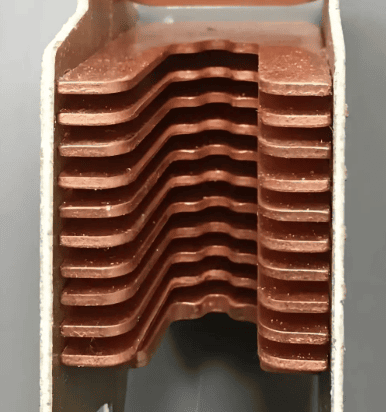
CuW tips are manufactured through powder metallurgy, creating a uniform tungsten skeleton embedded in a copper matrix. This structure prevents localized overheating—a common failure point in cast copper tips. When welding 2.4mm steel wire at 250A, 70W-Cu tips (70% tungsten) exhibit 62% less wear than chromium zirconium copper after 20 meters of continuous welding, maintaining precise wire alignment throughout.
2. Thermal-Mechanical Stability
During pulsed MIG welding, tips endure cyclic thermal stresses exceeding 500°C. CuW’s low coefficient of thermal expansion (CTE: 6.5×10⁻⁶/K) minimizes dimensional changes, reducing the risk of wire sticking. In contrast, beryllium copper’s higher CTE (13×10⁻⁶/K) causes 0.1mm expansion at 400°C, often leading to operational failures.
3. Electrical Erosion Resistance
Arc plasma temperatures can reach 20,000°C, vaporizing copper at rates of 0.03mm/min. Tungsten’s high boiling point (5930°C) reduces material loss by 78% compared to pure copper. This explains why aerospace manufacturers prefer CuW tips for aluminum alloy welding, where electrical erosion causes 45% of all tip replacements.
Critical Selection Criteria: Beyond Basic Specifications
1. Tungsten Content Optimization
- 60W-Cu: Best for low-current applications (<150A) like sheet metal assembly, offering 82% copper conductivity with moderate wear resistance.
- 70W-Cu: The industry standard for robotic welding (150-350A), balancing 72% conductivity with 65 HRC hardness.
- 80W-Cu: Reserved for specialized processes like laser-arc hybrid welding, where thermal loads exceed 500A.
Case Study: A German automotive supplier reduced tip consumption by 63% by switching from 65Cu-35CrZr to 70W-Cu for seat frame welding, despite a 22% higher unit cost. The ROI period shortened to 11 weeks due to fewer interruptions.
2. Geometric Precision
- Inner Bore Tolerance: Must be ±0.02mm of wire diameter to prevent eccentricity. A 2.4mm bore for 2.0mm wire reduces spatter by 59% compared to oversized 2.6mm bores.
- Conical Design: 15° tapered tips improve gas coverage, reducing porosity in aluminum welds by 41% versus cylindrical designs.
3. Surface Treatment
- Electroless Nickel Plating: Extends service life by 300% in high-spatter environments like shipbuilding.
- Diamond-Like Carbon (DLC) Coating: Reduces friction coefficient to 0.05, enabling smooth wire feeding even with corroded wires.
Industry-Specific Recommendations
Automotive Body-in-White Welding
- Requirement: 200-300A pulsed MIG for 1.2-2.0mm steel
- Solution: 70W-Cu tips with 2.6mm bore and 15° taper
- Outcome: 12,000 welds per tip vs. 3,200 for chromium copper
Aerospace Aluminum Welding
- Requirement: 400A AC-TIG for 6-12mm plates
- Solution: 80W-Cu tips with gas diffuser design
- Outcome: 85% reduction in tungsten inclusion defects
Heavy Equipment Manufacturing
- Requirement: 500A FCAW for 10-25mm steel
- Solution: 75W-Cu tips with water-cooling channels
- Outcome: Tip temperature stabilized at 180°C vs. 320°C for uncooled tips
Debunking Common Misconceptions
Myth 1: “Higher tungsten content always means better performance”
Reality: Beyond 80W-Cu, brittleness increases fracture risk during automated tip changes. A Japanese robotic welding trial showed 85W-Cu tips failing 47% earlier than 80W-Cu under identical conditions.
Myth 2: “All CuW tips are equally durable”
Reality: Sintering density directly impacts performance. Tips with <98% theoretical density erode 3x faster due to porosity-induced arc instability. Reputable manufacturers like Germany’s Plansee achieve 99.5% density through hot isostatic pressing (HIP).
The Future of Contact Tip Technology
Emerging innovations include:
- Gradient Alloying: Tungsten content increasing from 60% at the bore to 85% at the tip surface for localized wear resistance.
- Self-Lubricating Composites: Graphene-enhanced CuW reducing friction by 68% without conductivity loss.
- AI-Driven Predictive Maintenance: Sensors embedded in tips monitoring real-time wear and triggering replacements via IoT platforms.
Conclusion: Making the Strategic Investment
While CuW tips cost 3-5x more than brass alternatives, their total cost of ownership (TCO) proves 62% lower in high-volume applications. The key lies in matching tungsten content to process requirements—over-specifying wastes budget, while under-specifying causes production losses. By applying the selection framework outlined here, manufacturers can achieve the elusive balance of productivity, quality, and cost efficiency in modern welding operations.